Why Hotel Corridors Use Repeating Room Numbers
Hotel room numbers reveal how floors and corridors are organised, helping you read signs, choose the right wing and reach your room without backtracking.
Hotel room numbers usually repeat a simple pattern because guests and staff need a usable address inside a building. Hotel room numbers can indicate a floor, corridor or wing, but their exact logic is set by each property rather than by a universal code.
Why numbers repeat
A hotel often gives each floor its own range, using the first digit or digits to suggest the level and the remaining digits to distinguish rooms. A room labelled 624 might be on the sixth floor, for instance, but another hotel may use those digits to identify a zone or sequence instead.
Repeating a pattern across floors makes room locations easier to describe. If rooms in the 20s sit along one wing on one level, a similar arrangement above may help staff direct a guest or locate a room during routine service. The system is practical rather than ceremonial: it gives a building’s doors a shared address scheme.
Real buildings are less tidy than numbering plans. An added wing, a converted office or a service room can interrupt the sequence. A number is therefore a clue to location, not a promise that every corridor will follow the same arrangement.
Signs and sequences
Signs at lift lobbies and corridor junctions connect room numbers to directions. A sign showing rooms 601–620 points to a particular branch; door numbers then help confirm whether you are moving through that range in the expected order. Read the sign and the nearby doors together, rather than following the first number you happen to see.
Odd and even numbers may appear on opposite sides of a corridor, or they may be mixed into a continuous sequence. Either convention can work. The useful question is whether the door numbers near you are moving towards your room number, not whether they match a pattern you have seen elsewhere.
Wings and exceptions
Separate wings, annexes and connected buildings may reuse the same numerical range. The full address can include a wing name, letter or floor label, all of which matter as much as the digits on the door. Compare your key sleeve or booking details with the directory at the lift lobby before choosing a branch.
A gap in the sequence is not necessarily a lost room. The omitted number may belong to a cupboard, service area or door that was removed during a renovation; it may also be on the other side of the corridor. Check the nearby signs and both sides before deciding that you have taken a wrong turn.
If your assigned number itself seems absent, do not try handles or enter a room to investigate. Return to the lobby or contact reception and ask them to confirm the floor and corridor. Hotel numbering is a wayfinding tool, not permission to test doors.
Reading hotel room numbers?
Does the first digit always mean the floor?
No. It often suggests the floor, but some properties use a different convention or number a zone rather than a level. Check the lift display and floor directory, then ask reception if they conflict.
Why do room numbers skip?
A skipped number can reflect a service space, an altered layout or a numbering scheme that places odd and even rooms on opposite sides. Follow the next sign and the nearby sequence instead of assuming the room is concealed along the same wall.
Can two hotel rooms have the same number?
Separate wings or buildings may reuse a number. Check the complete room address on your booking details or key sleeve, including any wing name or letter, and ask reception to identify the correct corridor if it remains unclear.
What should I do if signs disagree?
Return to the nearest lift lobby or junction and compare the directory with your room details. If the signs still point to different locations, ask reception rather than choosing a corridor at random.
A worked route
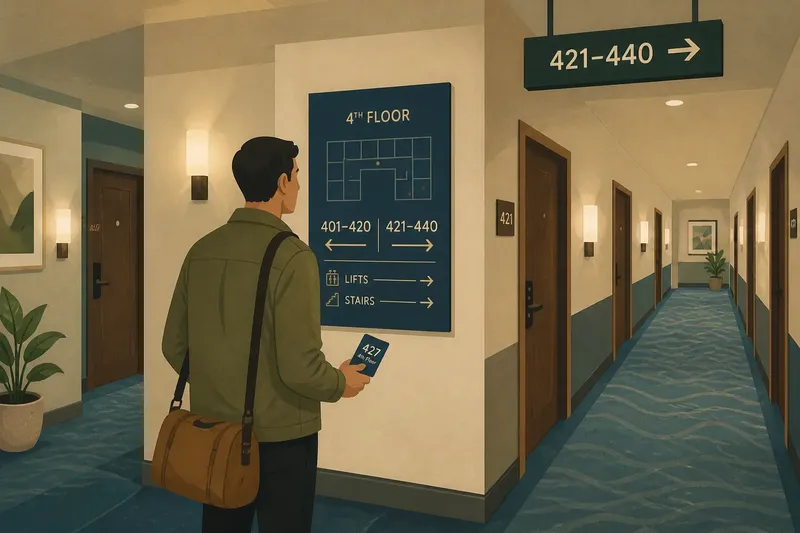
Imagine you have a room assigned as 427, and the fourth-floor directory shows 401–420 to the left and 421–440 to the right. You take the right-hand corridor, where the first doors are numbered 421 and 423; the rising sequence supports that direction. At 425, the corridor reaches a side passage with no range sign, so you pause and check the next door rather than assuming the passage continues the same run. If it shows 427, you have the right branch; if it shows a different range or no useful clue, you return to the junction and ask reception. The digits, directory and door sequence together give you a reasoned route without treating the building as a treasure hunt.
When you find the room, note the nearest junction and which way the numbers ran. That small detail makes the return from the lift easier. Hotel room numbers are most useful when read alongside floor directories, wing names and corridor signs: the repeating pattern gives the building an address system, while local signs explain how to use it.