From Coaching Inns to Grand Hotels: The Changing Welcome
The changing hotel welcome traces how travellers moved from the working yard of a coaching inn to the formal reception of a grand hotel.
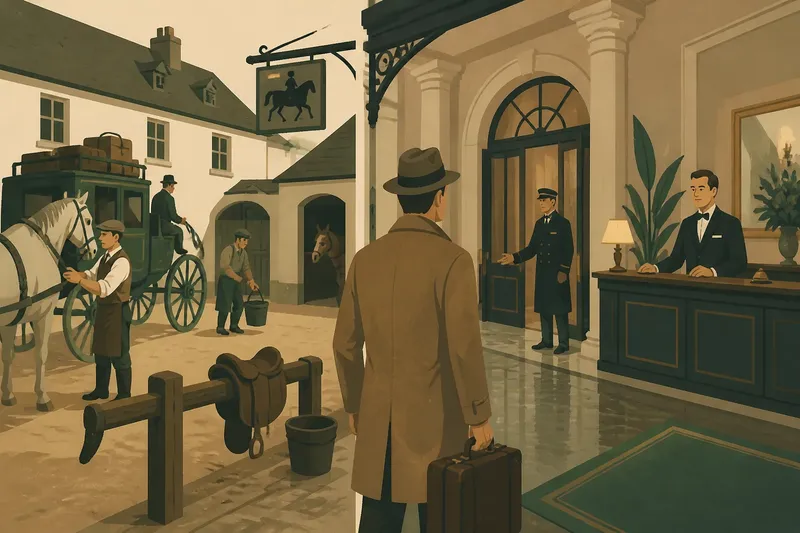
The changing hotel welcome is clearest in the journey from a coaching inn’s yard to a grand hotel’s reception room. In Britain, coaching inns served road travellers whose horses, meals and beds all needed attention; later urban hotels made the act of receiving a guest a more visible, specialised part of the stay.
That is a change in arrangement, not a tidy march from roughness to refinement. Inns and hotels both had to connect arrivals with shelter and service. Their buildings, staff roles and signals of welcome differed according to the work they were built to do.
Coaching inn yards
A coaching inn was organised around movement. Coaches needed access to a yard, horses needed care, and travellers needed somewhere to eat and sleep before continuing their journey. An arrival could begin at a gateway or among the practical activity of the yard, not at a dedicated reception counter.
The inn’s welcome was therefore closely tied to immediate needs. A traveller might be staying overnight, taking a meal or pausing while a coach was readied. The innkeeper and staff had to work out which service was required and direct the person accordingly. A busy yard was part of the welcome because it showed the building doing its job.
Urban hotel growth
As larger hotels developed in towns and cities, the work of receiving guests became easier to distinguish from other tasks. A central point could handle an arrival, establish the accommodation arrangement and direct the guest to the next part of the stay. Reception became a recognisable function within a larger operation, although luggage, room preparation and questions still involved other staff.
The difference was not that inns had no organisation or that hotels invented order. Rather, a larger establishment could divide work among more people and spaces. A guest might speak first to one member of staff, while someone else carried luggage or prepared a room. The welcome depended on these roles connecting without making the guest do the coordination themselves.
Grand hotel entrances
In the grand hotel, the entrance and public rooms could make arrival feel deliberate. A prominent doorway, a sheltered approach or a spacious lobby marked a transition from street to interior. These features also had practical uses: people could wait, meet companions, ask for directions or pause while staff dealt with luggage and rooms.
Consider an invented situation: a traveller arrives at a large hotel after rain, carrying a case and unsure where to go. A visible reception point and a staff member who acknowledges the arrival give the traveller a clear first action. The expected result is simple: the guest can ask for help without having to guess which corridor or doorway to try.
Architecture could signal status, but it also had to work. A grand entrance that led into an inscrutable maze would be an expensive way to make a poor first impression. The useful welcome joined appearance to orientation.
Formal service conventions
Grand hotels often presented service through conventions such as formal dress, measured language and defined staff roles. These practices could make a large establishment seem orderly and distinguish its style from that of a roadside inn. They also helped set expectations about who would respond to a request.
Formality was not automatically warmth. A polished greeting might reassure one traveller and strike another as stiff. The practical test was whether the exchange helped: a staff member who listened, gave clear directions and passed on a request offered more than an impressive manner alone.
Changing hotel welcome
In contemporary hotels, reservations may be arranged before arrival, and some guests use a phone or self-service machine for part of check-in. These options change where the first contact happens; they do not remove the need for a clear route to help when a booking, room or direction is unclear.
Across the historical shift, the work of welcome moved from the inn’s closely connected services towards more specialised roles and spaces. The changing hotel welcome still turns on a plain question: can a guest understand what to do next? A desk, a sign or a staff member can answer it, provided the arrangement fits the building and the needs of the person arriving.
Questions about hotel welcomes?
How did coaching inns welcome travellers?
Coaching inns received travellers in a working setting organised around coaches, horses, meals and beds. Staff connected each arrival with the practical service needed for that stop.
Why did hotels develop reception?
As larger hotels divided work among more staff, reception provided a recognisable point for handling arrivals and directions. It coordinated the welcome rather than replacing the work of porters, room staff or others.
What made a grand hotel entrance distinctive?
A prominent entrance and public rooms made the move from street to hotel more deliberate. They could signal the establishment’s style while giving guests somewhere to pause, meet or ask for help.
How has the hotel welcome changed?
Bookings and check-in can now begin before a guest reaches the building, or involve a machine or phone. The essential task remains practical: make the next action clear and provide a way to ask for assistance.